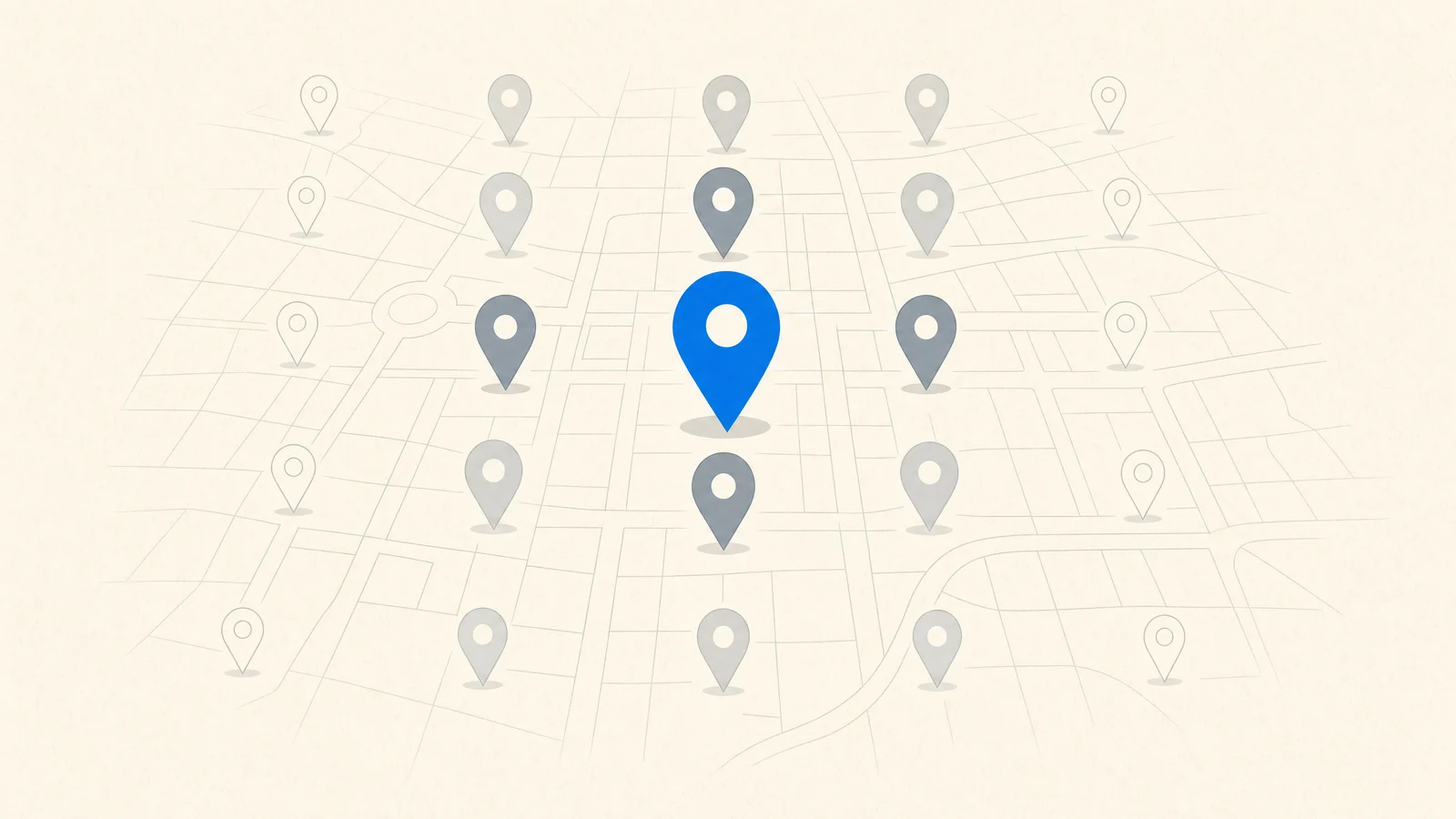
Every local business owner has had this conversation. You search your main keyword, you see yourself sitting at the top of the map pack, and you feel good about it. Then a customer across town says they could not find you, you search again from their neighborhood, and you are not on the first page at all.
Nothing broke. Nothing changed. You were never ranking #1 in the way you thought you were. You were ranking #1 where you were standing, which happened to be the one spot on earth where you have the largest possible advantage.
This is the single most misunderstood thing about local search, and it is the reason traditional rank tracking gives local businesses false confidence for months at a time. Local rank is not a number. It is a map. This guide explains why, how to see your real map, how to read what it is telling you, and which levers actually push the edges of it outward.
The factor you cannot turn off
Google has been unusually direct about how local results are ordered. Three things decide it: relevance, distance, and prominence. Google’s own documentation lays these out in plain language, and the order is not a hierarchy. They work together, and the weight of each one shifts by query and by market.
Relevance is how well your business matches what was typed. A plumber matches “emergency plumber near me” and does not match “dog groomer.” This is mostly decided by your primary category and reinforced by your services, your website, and your reviews.
Prominence is how well known and well regarded the business is. Reviews, links, citations, brand searches, and general web presence all feed it. This is the part that behaves most like classic SEO.
Distance is the one that breaks people’s mental model. It is measured from the searcher to you, not from you to anywhere. It changes every time the searcher moves. And unlike the other two, there is no optimization for it. You cannot earn a shorter distance. You can only build enough relevance and prominence that distance stops mattering as much.
Ranking first at your own address is the easiest ranking in local search. It is also the least informative one, because it is the only point on the map where nobody is closer than you.
That is why a business can be genuinely excellent, well reviewed, and completely invisible four miles away. Distance is doing the work at the center, and once you step outside it, whatever else you have built has to carry the listing on its own.
Why your rank tracker says #1
Most rank tracking tools were designed for organic search, where a single national or city-level position is a reasonable summary. They check a keyword from one location, usually a city center, and report one number.
For organic results that is close enough. For map results it is close to meaningless. A city is not a point. If your tracker checks “roofing contractor Orlando” from a coordinate downtown, it reports how you rank downtown. It says nothing about the suburbs where most of your jobs actually are.
Three failure modes come out of this, and all three are common:
- False confidence. The tracking point happens to sit near your address, so you see first place forever while your actual reach is a few blocks wide.
- False alarm. The tracking point sits in a competitor stronghold, so you look like you are failing in a market where you are strong everywhere else.
- Invisible progress. Your radius grows from one mile to four, which is a real and valuable win, and the single tracked number does not move at all because it was already first.
The third one is the expensive failure. Plenty of local campaigns get cancelled while they are working because the only measurement in the room could not see the thing that improved.
There is also the personalization problem. Searching your own business from your own phone, on your own network, while signed into an account that has visited your website hundreds of times, is not a measurement. It is a mirror. Incognito does not fix it either, because your location is still your location.
What a geo-grid scan actually is
A geo-grid scan solves this by refusing to pick one point. Instead of asking “where do I rank,” it asks the question dozens of times from dozens of coordinates arranged in a grid across your service area, then plots each answer on a map.
The output looks like a heat map. Each cell holds your position for that keyword from that exact spot. Green or blue where you are strong, gray or red where you are not. In one image you get the answer traditional tracking cannot give you: not whether you rank, but how far your ranking reaches.
Three settings decide whether the scan is useful or noise:
- Grid size. A 5x5 grid gives you 25 data points and a rough shape. A 7x7 or 9x9 gives you resolution to see where exactly the drop-off happens. Bigger grids cost more and take longer, so start at 5x5 and increase only where you need detail.
- Point spacing. The distance between adjacent points. Half a mile is right for a dense urban service area. Two to five miles is right for a rural one. Spacing too tight tells you about one neighborhood, spacing too wide skips the drop-off entirely.
- Keyword choice. Scan the query a customer would actually type, not your category name. "Emergency ac repair" and "hvac contractor" produce different maps for the same business, and only one of them is the query that pays.
We built a free local SEO map rank checker that runs this live on any business and any keyword, with the grid size and spacing under your control. There is no signup wall and no gated export, because the point of the tool is that you see the shape of your own problem before anyone tries to sell you a solution to it.

Three patterns and what they mean
Once you have a grid in front of you, the shape tells you which problem you have. There are really only three shapes worth learning, and they point at three completely different fixes. Reading the shape correctly is the difference between six months of useful work and six months of the wrong work.
Bright center, fading edges
- What it looks like
- First or second place in the middle few points, sliding into the teens and twenties as you move outward in every direction.
- What it means
- Your relevance is fine. Google understands what you do and matches you to the query. What you lack is the prominence to stay competitive once proximity stops carrying you.
- Where to start
- Reviews, links, mentions, and real content about the areas you are losing. This is the slowest pattern to fix and the most durable once fixed.
Weak everywhere, including at your own address
- What it looks like
- No point on the grid puts you in the top three, not even the one sitting directly on your building.
- What it means
- This is almost never a competition problem. Losing at your own front door means Google does not consider you a strong match for the query at all, or something is wrong with the profile itself.
- Where to start
- Check the primary category first, then the business name, then whether the profile is suspended, duplicated, or merged with another listing.
Scattered and inconsistent
- What it looks like
- Third place at one point, twenty-eighth at the point next to it, back to fifth two points over. No pattern that follows distance.
- What it means
- Distance produces smooth gradients. When the map is noisy instead of smooth, something other than distance is deciding, which usually means conflicting data about who and where you are.
- Where to start
- Hunt for duplicate listings, NAP conflicts across directories, and old profiles from a previous address or a previous owner.
One nuance worth holding on to. The fading pattern is normal. Every business on earth has one, including the market leader. The question is never whether your rankings fade with distance, it is how far out the fade begins and how steeply it falls. A dominant local business and a struggling one can have identically shaped grids at different scales.
So compare against competitors, not against perfection. Run the same grid on the two or three businesses beating you and see where their edges sit. That comparison turns a vague “we need better local SEO” into a specific, mappable target.
Primary category, the biggest lever
If the grid says you are weak even at your own address, start here and do not touch anything else until you have. Primary category is the strongest single relevance signal on a Google Business Profile, and it works more like a filter than a boost. The wrong primary category does not make you rank lower for a query. It can make you ineligible for it.
The common mistake is choosing the category that best describes the business rather than the one that best matches the query you want. A firm that does personal injury, family law, and estate planning is genuinely a “Law Firm.” But if the money is in injury cases, “Personal Injury Attorney” as primary and “Law Firm” as secondary will do far more for the grid.
The specific category is nearly always the stronger choice. “Roofing Contractor” beats “Contractor.” “Emergency Dental Service” beats “Dentist” for urgent queries. Specificity is free relevance, and most profiles leave it on the table.
Secondary categories matter, but not nearly as much as people hope. They broaden which queries you are eligible for, they do not meaningfully strengthen your position in any of them. Adding nine of them to cover every service you offer dilutes nothing, but it also rescues nothing. The primary is the lever.
One warning: changing your primary category redraws the grid, sometimes dramatically and sometimes in the wrong direction. Run a scan before you change it and another two weeks after, so the change is measured rather than guessed at.
Free, no signup
Stop guessing at the shape of your problem.
Run a live geo-grid scan on your own business and keyword. You will know within two minutes whether you have a reach problem, a relevance problem, or a data problem.
Open the map rank checkerReviews, velocity, and geography
Reviews are the most reliable way to push the edges of the grid outward, and the way most businesses approach them wastes most of the effect.
Total count matters least. Star average matters more, mostly as a click-through and conversion factor once you are visible. What moves rankings is velocity, meaning a steady stream over time rather than a burst, and the language inside the reviews.
That language is not decoration. When Google attaches a justification to your map listing, the quoted phrase is frequently pulled straight from review text. A listing that shows “‘fixed our water heater the same day’” under the business name is showing the searcher a match they can read. Reviews that say “great service, highly recommend” give Google nothing to work with.
So ask for specifics. Not a script, which produces obviously templated reviews and helps nobody, but a prompt: ask the customer what job you did and where. “Which service did we do for you, and what part of town are you in?” is a natural question that produces naturally useful text.
Forty reviews spread across every neighborhood you serve will widen a grid more than two hundred reviews from customers who all live within a mile of your office.
Geographic distribution is the underused part. If every review comes from one zip code, you have reinforced the area where you were already strong. If reviews arrive from across the metro, you are accumulating relevance signal tied to places where proximity is working against you, which is exactly where you need help.
Practically, that means the review request should follow the job, not the calendar. Ask on site, at the moment the work is done, from wherever the work happened. A monthly email blast to your customer list produces reviews clustered around whoever opens email, which correlates with nothing useful.
Respond to all of them, including the good ones. Response rate is a visible signal of an actively managed profile, and the response text is additional indexable content attached to your listing.
Pages that name real places
Your website supports the profile. Google reads it, connects it to the listing, and uses it to decide what you are relevant for. This is where the phrase “their website mentions” comes from in map results, and it is a direct, observable link between page content and map visibility.
Which is why location pages exist, and why almost all of them are done badly. The standard failure is a template with the city name swapped in twenty times, producing twenty pages that differ only in a variable. Those pages do not fail because Google detects duplication and punishes them. They fail because they contain no information, so they earn no links, no engagement, and no reason for anyone to treat them as evidence of anything.
A location page that actually helps the grid contains things only a business working in that area would know:
- Named neighborhoods and landmarks. Not just the city. The subdivisions, districts, and crossroads people actually use when describing where they live.
- Work you have genuinely done there. Project descriptions, timelines, conditions specific to that area. Older housing stock, hard water, clay soil, hurricane exposure, whatever is true.
- Local constraints that change the job. Permit offices, HOA rules, inspection quirks, seasonal restrictions. This is the content competitors cannot copy because they would have to know it.
- Reviews from customers in that area. Pulled onto the page, attributed to the neighborhood, tying the location content back to real people.
- A real reason the page exists. If you would not send this page to a prospect in that city, it is not going to convince a search engine either.
This is the approach behind our own city pages for Orange City, Sanford, Daytona Beach, and Orlando. Five real pages beat fifty templated ones, and they are far less likely to age into a liability.
Underneath all of it, the entity has to be unambiguous. LocalBusiness structured data that matches your profile exactly, consistent NAP everywhere it appears, and one canonical version of your business name. None of that wins rankings by itself. All of it stops you from losing them for reasons that have nothing to do with your marketing.
The profile fields that carry weight
Beyond the category, a handful of profile fields do real work and the rest are mostly housekeeping. Worth the time:
- Services. Every service you offer, named the way customers name it. These feed relevance directly and are the cheapest win on the entire profile.
- Products. Underused by service businesses, and they render as a visible module on the listing. Even for services, packaging offers as products adds indexable detail.
- Service areas. For SABs, this is your declared coverage. It does not override proximity, but declaring areas you do not serve dilutes relevance and declaring none at all wastes the field.
- Business description. Read by Google, not just by humans. Say plainly what you do and where, without stuffing.
- Attributes and hours. Hours affect eligibility for "open now" filtered queries, which is a meaningful slice of urgent local search. Wrong hours cost you those impressions silently.
- Photos. Regular uploads correlate with engagement, and engagement correlates with prominence. Geotagging photos does not do what the internet says it does.
A fully completed profile is not a ranking factor in the way people describe it. What it does is remove every cheap reason for Google to prefer a competitor whose profile answers a question yours leaves blank.
Prominence, links, and mentions
Prominence is the slowest of the three factors to move and the one that holds the grid open once it is moved. It is also where local SEO stops being different from regular SEO.
Links from sites in your geography carry a signal that generic links do not. A local news site, a chamber of commerce, a supplier, a regional trade association, a sponsored youth league, a local charity. These are not link-building schemes, they are the ordinary evidence that a real business operates in a real place.
Citations, meaning your NAP on directories, matter less than they did a decade ago and are still worth getting right once. The value now is consistency rather than volume. Twenty accurate listings beat two hundred with three different phone numbers among them. Inconsistent citations are one of the most common causes of the scattered grid pattern.
Branded search volume is the quiet one. When people search your business name directly, across a wider area over time, that is prominence in its purest form. It is also why local paid campaigns and offline marketing often lift map rankings months later in a way nobody attributes correctly.
If the fading pattern is your problem, this section is your work. It is the least satisfying answer because none of it moves the grid this week, and it is the only one that holds.
Multi-location and overlapping grids
Everything above assumes one location. Add a second and the math changes, because your two profiles now compete for the same searches in the overlap between them.
Google filters map results so that a single business rarely occupies multiple spots in one pack. In the overlap zone, one of your locations wins and the other is filtered out. Which one wins is decided by the same three factors, which means a weaker second location can be permanently suppressed by a stronger first one across territory it was opened to serve.
Grid scanning is close to mandatory once you have more than one location, because it is the only way to see:
- Where the boundary actually sits. The line where location A stops winning and location B starts is never the midpoint, and it is never where the org chart says it is.
- Uncovered gaps. Territory between locations where neither profile is competitive, which is invisible from either location dashboard.
- Cannibalized locations. A newer site that never ranks anywhere because an established one filters it out of every pack in range.
For franchises the problem compounds, because the locations are separately owned and each owner is measuring their own performance. Two franchisees five miles apart can both be doing everything right and one of them will still lose most of the contested area. That is a territory design problem, not a marketing one, and it is why franchise SEO has to start from a map of the whole system rather than a checklist applied per location.
At larger scale the same logic drives enterprise SEO: with dozens or hundreds of profiles, no one can look at individual listings, and grid data becomes the only practical way to find which locations are underperforming their geography rather than just their revenue target.
What does not widen the radius
A fair amount of local SEO advice targets the proximity problem directly, and most of it either does nothing or actively costs you the listing.
- Virtual offices and mailbox addresses. Against Google guidelines, routinely detected, and the penalty is losing the profile rather than losing a few positions. The risk is not proportional to the upside.
- Keyword stuffing the business name. It does work, which is why people do it. It is also a guideline violation any competitor can report in about thirty seconds, and reinstatement is not guaranteed.
- Expanding service areas to cover everything. Listing forty cities does not extend your radius. Service areas describe where you travel, they do not move where you are.
- Geotagged photo uploads. A persistent myth. EXIF location data in uploaded photos is not used to determine ranking, and stripping or adding it changes nothing.
- Posting daily to Google Posts. Good for engagement and offers. Not a ranking lever, and treating it as one burns time that reviews would repay.
- Buying citations in bulk. Volume stopped helping years ago. A bulk submission that introduces one inconsistent phone number does measurable harm.
The honest summary is that there is no trick for proximity. There is only building enough of the other two factors that distance carries less of the decision, which is slow, and there is opening a location closer to the demand, which is expensive. Everything sold as a third option is one of those two wearing a costume, or a guideline violation.
Run your own grid scan
Reading about this is worth less than looking at your own map for two minutes. Here is the sequence we use at the start of every local engagement.
- 1Pick the query that pays. One keyword, the one that produces booked work. Not your category name, not a variation you like the sound of. If you are unsure, use the phrase that appears most in your call recordings.
- 2Scan your own business first. Start with a 5x5 grid and spacing matched to your real service area. Note where the drop below third place happens in each direction.
- 3Scan your two closest competitors. Same keyword, same grid, same spacing. This is the step almost everyone skips and it is the one that turns the data into a plan.
- 4Name the pattern. Fading, flat, or scattered. Do not proceed until you can say which one you are looking at, because the three lead to different work.
- 5Fix in the right order. Scattered means data cleanup first. Flat means category and profile integrity first. Fading means reviews, content, and links, in that order of speed.
- 6Rescan monthly, same settings. Same keyword, same grid, same spacing, or the comparison is meaningless. Track the position of the edge, not the average.
You can run steps two and three right now in the map rank checker. If you want the rest of the picture, the SEO checklist covers the site-side work that has to be true before any of this compounds, and an SEO audit is where we look at the grid, the profile, and the site together rather than one at a time.
The goal is not a perfect grid. Nobody has one. The goal is knowing exactly where your edge is, watching it move outward, and being able to tell the difference between a campaign that is working slowly and one that is not working at all. A single tracked keyword cannot tell you that. A map can.
Questions people actually ask
Why do I rank #1 at my office but not at my house across town?
Because proximity is measured from wherever the searcher is standing, not from your address. At your office you are the closest matching business, so you win by default. Three miles away, a competitor is closer, and unless your relevance and prominence are strong enough to outweigh that distance, they take the spot. Ranking at your own address is the easiest ranking there is and tells you almost nothing.
How far from my address can a Google Business Profile realistically rank?
There is no fixed number. The radius depends on how dense your category is in that area. A specialty surgeon in a rural county may rank across forty miles because there is nobody else. A pizza place in a city may lose the pack after eight blocks. Density of competitors, not distance alone, sets the ceiling.
Can I rank in a city where I do not have an address?
Yes, but it is much harder and the mechanism is different. You are relying on relevance and prominence to overcome a proximity deficit, which means genuinely useful pages about that city, reviews from customers there, links and mentions from sources in that area, and a service area on your profile that covers it. What you cannot do is create a fake address there. That is the fastest way to lose the profile entirely.
Does moving my business address change my map rankings?
Immediately and significantly. The entire grid shifts with you. Moving a mile toward the dense part of town can visibly widen your coverage, and moving out of it can shrink it just as fast. If you are considering a move, run a grid scan from the prospective address area first by checking which competitors dominate there.
What is a good average map rank position on a grid scan?
Judge the shape before the number. An average of 4.2 made up of first place at the center and twentieth at the edges is a very different business problem than a flat 4.2 across every point. The first is a reach problem. The second means you are close to breaking into the pack everywhere at once, which is usually the easier fix.
How often should I run a geo-grid scan?
Monthly is enough for most businesses, on the same keywords and the same grid settings each time so the results are comparable. Run one extra scan any time you change your primary category, move, or finish a review push, because those are the changes most likely to redraw the map.
Do service area businesses rank worse than storefronts?
Not inherently, but they get less benefit from the one lever that is free. A storefront gets proximity strength around a fixed point whether it earns it or not. A hidden-address profile still ranks outward from its registered address, so it has the same center, just without walk-in relevance signals. The gap shows up in how much the rest of the profile has to compensate.
Does adding my address in the website footer help map rankings?
It helps confirm the entity, which matters, but it is not a ranking lever on its own. Consistent name, address and phone on the site, matching the profile exactly, is table stakes. It stops you losing points, it does not win them.
Why did my rankings drop everywhere at once with no other changes?
A uniform drop across the whole grid usually points at the profile rather than the market: a category change, a suspended or merged listing, a duplicate that started competing with you, or an edit someone else suggested and Google accepted. Uniform movement is a profile event. Movement only at the edges is a competition event.
Joshua Rouillard
Founder, RouillardMedia
Joshua has spent over a decade in performance marketing and search. He founded RouillardMedia, where the team runs local campaigns for single-location businesses, multi-location brands, and franchise systems, and built the free map rank checker because most owners have never seen what their rankings actually look like.