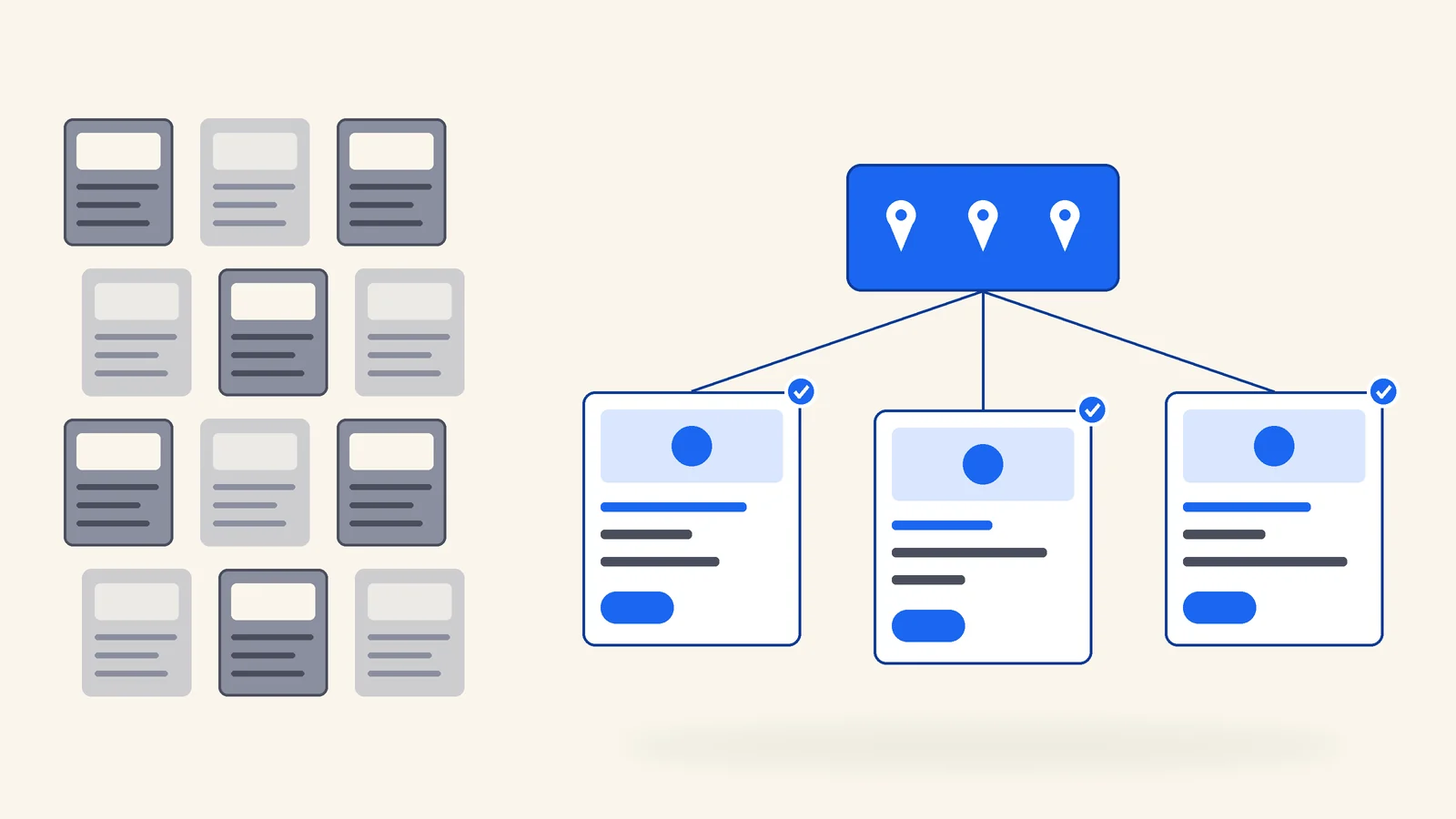
Every franchise system eventually builds the same thing: one page per location, generated from a template, with the city name dropped into the headline. Some of those systems rank in every market they operate in. Others watch half their location pages sit unindexed while a competitor with a fraction of the locations takes the local results.
The difference is rarely the template. It is whether each page contains anything a searcher could not get from the page next to it, and whether search engines can find the pages at all. This guide covers both, using Google's own policies as the line to build against.
Why franchise location pages get ignored
Franchise location pages fail for three predictable reasons, and they often stack.
- They are the same page. Brand copy, a service list, and a stock photo, with the city and phone number swapped. Search engines have little reason to index fifty versions of one page.
- Nothing links to them. The only path to a location page runs through a map widget that crawlers cannot operate, so the pages exist but are hard to discover.
- They target places the business is not. Pages for every town near a territory, created to capture searches rather than describe a location, drift into territory Google names in its spam policies.
Each has a structural fix, and none of them requires abandoning templates. Templates are how you keep fifty pages consistent. The question is what fills them.
Where Google draws the doorway line
Google's spam policies define doorway abuse as sites or pages created to rank for specific, similar search queries. Two of the examples Google lists are directly relevant to franchises:
“Having multiple domain names or pages targeted at specific regions or cities that funnel users to one page.” And: “Creating substantially similar pages that are closer to search results than a clearly defined hierarchy.”
Read those carefully and the safe zone becomes clear. The problem is not having many pages about places. The problem is pages that are substantially similar, that funnel users to one destination, and that behave like a list of search results instead of sitting in a clearly defined hierarchy. A real location page, reachable from a real directory, describing a real place, sits on the right side of every one of those phrases.
The same policy page also defines scaled content abuse: many pages generated for the primary purpose of manipulating search rankings and not helping users. That applies however the pages were produced, which matters for systems tempted to generate hundreds of city pages at once.
The swap test
A fast way to audit any location page: take a paragraph and mentally swap in a different location from your system. If the paragraph is still true, it is template content. Template content is fine in supporting roles. It cannot be the reason the page exists.
| Page element | Still true after a swap? |
|---|---|
| Intro paragraph about the brand and its services | Yes, template |
| "Proudly serving Tampa and surrounding areas" | Yes, template |
| Street address, hours, and local phone number | No, unique |
| Names and photos of the team at this location | No, unique |
| Neighborhoods and towns this territory actually covers | No, unique |
| Services this location offers that others do not | No, unique |
| Reviews left by customers of this location | No, unique |
| Parking, access, or arrival instructions | No, unique |
A page where most of the visible content lands in the first category is the page Google's policy describes. A page where the unique rows carry the weight is a location page. Notice that almost every unique row depends on information only the franchisee has, which is why the ownership split in our franchise SEO strategy guide assigns local content to the location and the template to the brand.
A locator crawlers can follow
Store locators are built for people: type a ZIP code, see pins, click a result. That interaction is often driven entirely by JavaScript, and the location pages behind it may never appear as ordinary links. Google's link crawlability documentation is direct about the requirement: Google can only reliably crawl a link if it is an <a> element with an href attribute. It lists patterns it cannot parse, including anchors that navigate through onclick and elements like span carrying an href.
<!-- Not reliably crawlable: no href, navigation happens in JavaScript -->
<div class="result" onclick="openLocation('tampa-fl')">Tampa, FL</div>
<a onclick="goto('/locations/orlando-fl')">Orlando, FL</a>
<span href="/locations/miami-fl">Miami, FL</span>
<!-- Crawlable: real anchors with href, rendered with the page -->
<nav aria-label="Florida locations">
<h2>Florida</h2>
<ul>
<li><a href="/locations/miami-fl">Miami, FL</a></li>
<li><a href="/locations/orlando-fl">Orlando, FL</a></li>
<li><a href="/locations/tampa-fl">Tampa, FL</a></li>
</ul>
</nav>Keep the map. Add a plain directory beneath it, or on its own /locationspage, that lists every location as a real link. Once a system spans many states, split the directory into state or region hubs so each hub links to its locations and the hierarchy is obvious. That hierarchy is the “clearly defined hierarchy” the doorway policy contrasts against.
Two supporting details: include every location URL in the XML sitemap, and link each location page back to its hub and to nearby locations where that genuinely helps a customer who landed on the wrong one.
Franchise SEO
Location pages built from real location data
We design the template, build the crawlable directory, and run the intake that gets real team, service, and area details from every franchisee.
See franchise SEO servicesarrow_forwardAnatomy of a location page
The template below separates what the brand supplies once from what each location supplies. The order roughly follows what a searcher needs first.
- Name, address, phone, and hours near the top, matching the Business Profile exactly. Include holiday hours when they differ.
- A map and directions with the practical details: parking, entrance, nearby landmarks, or for service-area locations, the areas covered.
- The team. Owner and staff names, photos, and how long they have served the area. This is usually the most distinctive block on the page.
- Services offered here. Not the brand master list. The services this location actually provides, including anything location-specific.
- Local proof. Reviews from customers of this location, local licenses or certifications, community involvement, photos of real work in the area.
- Brand context in a supporting role: a short block on what the brand stands for, identical across pages and kept brief.
- Location-specific FAQs, answered by the franchisee, such as appointment policies, service radius, or payment options that vary by location.
- Structured data describing this location and connecting it to the brand, covered in LocalBusiness schema for multiple locations.
Independent ownership: many franchise systems require a visible notice that each location is independently owned and operated. The location page is the natural place for it, and it matters again when you write that location's structured data.
Service-area franchises and city pages
Home service franchises, such as cleaning, restoration, pest control, and lawn care, feel this problem most. Customers search by town, the franchisee covers a dozen towns, and the tempting move is a page per town.
Google's Business Profile guidelines model service-area businesses as one profile for the central office or location, with a designated service area. A business with multiple locations that have separate service areas and separate staff can have one profile per location. That is a useful model for the website too: the unit is the location, and the towns are attributes of it.
The defensible structure is one location page per franchise territory, with a clear areas-served section listing the towns and neighborhoods covered. A separate area page earns its place only when it has content that is genuinely different: a distinct team or office for that area, local regulations that change the service, or real project work documented there. A page per town whose only difference is the town name is exactly the pattern the doorway policy describes.
Proximity still limits how far a single location ranks in the map results, whatever the website says. If you need to understand why a location wins its own neighborhood and fades a few miles out, read how proximity shapes rankings for multi-location businesses.
Connecting the page to its Business Profile
The website field on each location's Business Profile should point to that location's page. A searcher who taps through from a Tampa profile should land on Tampa hours and a Tampa phone number, not a homepage asking them to search again.
Google's guidelines also restrict what that field can contain. They prohibit URLs and phone numbers that redirect or refer users to landing pages or phone numbers other than those of the actual business, including pages on social media sites. A location page on the brand domain is the actual business. A separate lead capture page owned by a vendor is harder to defend.
Consistency across the two matters in both directions. The name, address, phone number, hours, and primary services on the page should match the profile, and when one changes, both change. Google also requires chain locations in the same country to share the same business name, so a location page headline can include the city for readers while the business name in the NAP block stays the brand standard.
Rolling out fifty locations at once
The risk in a large rollout is publishing the template before the local content exists. A safer sequence:
- Build the directory and URL structure first, and lock the URL pattern.
- Send every franchisee a structured intake: team, photos, services offered, areas served, local FAQs, community involvement.
- Publish locations as their intake is complete, rather than all at once with placeholder copy.
- For locations still waiting on content, publish the essentials (address, hours, phone, map) and keep them in the directory so customers can still find them. Add the local content as it arrives.
- Update each Business Profile website field once the page is live.
- Validate structured data on a sample of pages, then on every page.
- Review indexing for the location URLs in Search Console after rollout, and prioritize enriching any page that stays unindexed.
Location pages are not a one-time project. Teams change, services expand, and locations open and close. The franchise lifecycle checklist covers what to do with a location page when a location is sold, moves, or closes.
Questions people actually ask
Are location pages doorway pages?
expand_more
Not inherently. Google's spam policies describe doorway abuse as pages created to rank for specific, similar queries, including substantially similar pages that are closer to search results than a clearly defined hierarchy. A location page for a real location, with details only that location has, inside a crawlable directory, is the opposite of that description. Pages for cities where you have no location and no distinct content are where the risk sits.
How many words should a location page have?
expand_more
There is no word count Google publishes for location pages, and padding a page to hit a number usually adds exactly the templated copy that makes pages look alike. Judge the page by whether it answers what a customer of that location needs: where it is, when it is open, who works there, what it offers that others in the system do not, and how to contact it.
Should a franchise create a page for every city in a territory?
expand_more
Usually not. A page per real location is defensible. A page per town inside a territory, with the same services and the town name swapped, closely matches the doorway examples in Google's spam policies. List the areas served on the location page instead, and only build a separate page when there is genuinely distinct content for that area.
What URL structure is best for franchise location pages?
expand_more
A consistent, readable hierarchy on the brand domain, such as /locations/ for the directory and /locations/city-state/ for each location, with state or region hubs added once there are enough locations to need them. The exact pattern matters less than keeping it stable, because changing location URLs later forces redirects across the whole system.
Can a store locator map hurt SEO?
expand_more
The map itself does not, but a locator that only reveals locations through JavaScript interactions can hide every location page from crawlers. Google states that it can only reliably crawl links that are <a> elements with an href attribute. Pair the map with a plain HTML list of links to every location page.
Should the Google Business Profile link to the location page or the homepage?
expand_more
For a multi-location brand, linking each profile to its own location page sends searchers to the address, hours, and phone that match the profile they clicked. Google also prohibits profile URLs that redirect or refer users to landing pages other than those of the actual business, so the link should go to a real page for that location.
Do franchise location pages need schema markup?
expand_more
They are the best place for it. Each location page can carry LocalBusiness markup for that location, connected to the brand Organization. Our separate guide on LocalBusiness schema for multiple locations covers the exact structure.
Can AI write franchise location pages?
expand_more
Google's scaled content abuse policy applies regardless of how the pages are produced. The problem is generating many pages primarily to manipulate rankings. Automation can assemble verified location data into a consistent template, but the unique content that makes each page worth indexing has to come from real information about that location.
Joshua Rouillard
Founder, RouillardMedia
Joshua has spent over a decade in performance marketing and search. He founded RouillardMedia, where the team builds local and multi-location search programs, and writes about what actually moves the needle rather than what sounds impressive.