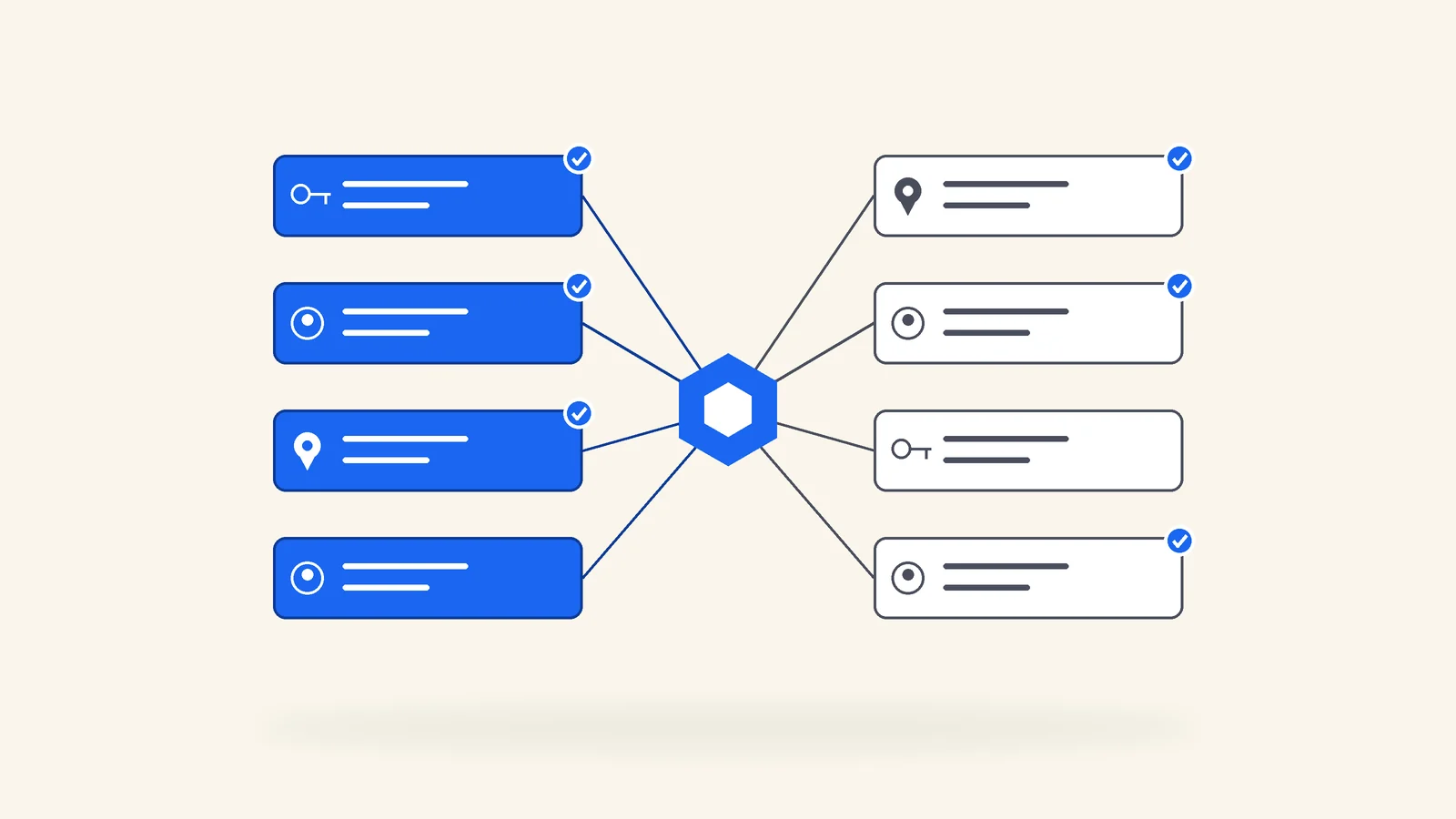
Most franchise SEO guides start with keywords and location pages. That is the easy half. The hard half, and the reason franchise systems stall in search, is that nobody wrote down who owns the domain, who is primary owner on each Google Business Profile, who answers reviews, and what happens to all of it when a franchisee sells.
Those questions have answers, and several of them are set by Google policy or federal franchise disclosure rules rather than by preference. This guide works through each asset in a franchise search program, who should control it, and why, then covers the moments when control actually gets tested: openings, resales, relocations, and closures.
Franchise SEO is an ownership problem
A single-location business has one decision maker. A franchise system has at least two, and their incentives overlap without being identical. The franchisor wants consistent brand presentation and search equity that accumulates on assets it keeps. The franchisee wants leads for their territory, this month, and control over the things customers see about their location.
When ownership is undefined, the same failure patterns repeat across systems:
- Franchisee microsites. An owner buys a city domain, copies brand content, and starts competing with the location page the franchisor built for them.
- Orphaned profiles. A Business Profile was created by a franchisee or a former agency, and nobody at corporate can edit it.
- Name drift. Locations append cities or services to their profile names to rank, breaking the consistency Google requires of chains.
- Resale resets. A new owner creates a fresh profile and website instead of inheriting the existing ones, abandoning years of reviews and links.
None of these is a keyword problem. Each one is fixed by deciding ownership before the work starts, which is also why our franchise SEO engagements begin with an access and ownership inventory rather than a keyword list.
The control map: who owns what
The table below is the default split that holds up best across resales and terminations. Your franchise agreement may already decide some of these rows, and where it does, the agreement wins. The principle behind the default is simple: the brand owns the assets rankings accumulate on, and the location owns the activity that makes those assets locally relevant.
| Asset | Franchisor | Franchisee | Why |
|---|---|---|---|
| Domain and DNS | Owns and renews | No registration of brand domains | The asset every ranking accrues to |
| Site template and location page structure | Owns | Supplies local content | Consistency and crawlability |
| Location page content | Approves | Writes team, services, photos, community | The part that makes pages unique |
| Google Business Profile | Primary owner in a business group | Manager or owner | Survives resale and termination |
| Review responses | Sets the policy | Responds day to day | Speed and local voice |
| Citations and data aggregators | Manages centrally | Reports changes | One source of truth for NAP |
| Local links and sponsorships | Provides guidelines | Earns them | Only locals have the relationships |
The domain and the website
The single most consequential decision in franchise SEO is whether locations live on the brand domain or on their own. The case for one domain is strong, and it rests on more than authority.
Authority accumulates where links point. A local news mention of the Tampa location that links to a subfolder on the brand domain strengthens the whole domain. The same mention linking to a franchisee microsite strengthens a site that disappears if that franchisee leaves the system.
City domains are a named spam pattern. Google's spam policies define doorway abuse as sites or pages created to rank for specific, similar search queries, and list as an example having multiple domain names or pages targeted at specific regions or cities that funnel users to one page. A network of near-identical franchisee sites sits uncomfortably close to that description.
Domains are trademark assets. Legal guidance on franchise agreements commonly recommends that the franchisor retain ownership of domain names, prohibit franchisees from registering domains that replicate the brand, and define what happens to domains at termination. IP Twins lays out these clauses in detail. If your agreement is silent on domains, that is a conversation for franchise counsel, not your SEO provider.
The practical architecture is one domain, a crawlable location directory, and one page per location, such as /locations/tampa-fl. What goes on those pages so they are not interchangeable is a topic big enough for its own guide: franchise location pages that are not doorway pages.
The test for any franchisee website request: if this franchisee left the system next year, where would the search equity this site built end up? If the answer is nowhere, build the content on the brand domain instead.
Google Business Profile ownership
Google's Business Profile guidelines do not say whether a franchisor or franchisee should own a location's profile. They do set several rules that shape the answer.
- Names must match across the chain. Google requires locations of the same business in the same country to use the same name, unless real-world branding consistently differs by location. Appending a city or a service to rank is not allowed.
- Only the primary owner can transfer primary ownership. Per Google's user management help page. New owners and managers also wait 7 days before they can remove other users or make someone primary owner.
- Website and phone must belong to the business. Google prohibits URLs and phone numbers that redirect or refer users to landing pages or numbers other than those of the actual business. A franchisee pointing the profile at a lead-gen page they own separately is a risk.
- Bulk verification has limits. Google's bulk verification page requires 10 or more profiles from the same business and excludes service-area businesses, which covers a large share of home service franchises.
Put together, the durable arrangement is the franchisor as primary owner of every profile inside a business group, with each franchisee added as a manager or owner of their own location. The franchisee keeps day-to-day control of posts, photos, and review responses. The brand keeps the one permission that matters when a location changes hands.
If profiles already exist under franchisee or former vendor accounts, inventory them before doing anything else. For each location, record the primary owner, every other user, the website URL, the primary category, and whether the name matches the brand standard. That spreadsheet is the foundation of every other fix.
What Item 11 of the FDD already tells you
Franchise systems in the United States have a document most marketing teams never read: the Franchise Disclosure Document. The FTC's Franchise Rule compliance guide explains that Item 11 must disclose the franchisor's advertising assistance, including:
- whether the franchisor is obligated to conduct advertising
- the media used, with the Internet listed alongside print, radio, and television
- the geographic scope of the advertising, whether local, regional, or national
- whether franchisees must contribute to an advertising fund or spend a set amount locally
- the role of any advertising councils or cooperatives
- who administers the fund, whether it is audited, and the percentage used to solicit new franchise sales
Item 11 also covers required computer systems and whether the franchisor has access to information in them. For SEO, that matters because it frames what data the franchisor can use in reporting.
This is useful in two directions. For franchisors, the disclosures define what you have already promised, so an SEO program paid from the brand fund should be consistent with how the fund is described. For franchisees, it tells you whether a local marketing spend requirement exists and whether SEO work you pay for yourself counts toward it. Neither side should guess. Read Item 11 and the matching agreement sections, and involve franchise counsel for anything ambiguous.
What franchisees should own locally
Centralizing ownership does not mean centralizing all the work. Several of the signals that move local rankings can only be produced by the people running the location, which is why good franchisee SEO is mostly operational rather than technical.
- Reviews. Asking every satisfied customer, and responding to every review within the brand's response policy. The franchisor writes the policy; the franchisee has the customer relationship.
- Real photos. The team, the storefront, the trucks, completed jobs. Stock imagery repeated across 40 locations tells neither customers nor search engines anything local.
- Local content for the location page. Who works there, which neighborhoods they actually serve, local licenses, and community involvement, supplied through a template.
- Local links and mentions. Chamber memberships, youth sponsorships, local press. These links should point at the location page on the brand domain.
- Reporting changes. New hours, a new phone number, a temporary closure. The franchisee knows first, and a central team can only keep listings consistent if it hears about it.
What franchisees should not do is equally concrete: register brand domains, create new Business Profiles, edit the business name, change the primary category without approval, or hire a separate vendor that builds city pages outside the brand site. Each of those creates a second source of truth.
When a location opens, sells, moves, or closes
Ownership decisions are invisible until a location changes. These four events are where a franchise system either keeps its search equity or throws it away.
A new location opens
Publish the location page before opening day so it can be crawled and linked from the location directory. Create the Business Profile inside the brand's business group, with the franchisee added as a user, and set the website field to the location page rather than the homepage. Submit consistent name, address, and phone data to the major data aggregators once, from the central source. Then let the franchisee start the review and photo work.
A franchisee sells the location
Google is explicit here. Its review help page says that if a business has a new owner or manager but keeps the same name, the reviews remain, and it says not to create a new Business Profile because of a change in ownership. The work is to remove the departing owner from the profile, add the new owner, and update the location page team section. If the franchisor already holds primary ownership, this takes minutes. If the departing franchisee holds it, the transfer depends on their cooperation, which is exactly the situation to avoid.
A location relocates
According to the same Google page, if you move to a new address and keep the same business name, Google transfers reviews automatically. Update the address on the existing profile rather than creating another one, update the location page and its schema, and push the new address through citations. Keep the location page URL the same if the city is unchanged. If the move changes the city in the URL, permanently redirect the old page to the new one; Google's redirect documentation notes that permanent redirects are used as a signal that the target should be canonical.
A location closes
Mark the profile permanently closed rather than deleting it, and Google notes that reviews remain on a closed profile. For the location page, the most helpful outcome for the searcher decides the redirect: send it to the nearest open location if one genuinely serves the same customers, or keep a short page that says the location closed and links to the location directory. Remove the location from the directory, the sitemap, and the aggregators.
A rebrand is its own case. Google's guidelines treat some name changes as a new business, in which case the existing profile is marked closed and a new one created. Check the current criteria before a system-wide rename, because it changes the rollout plan for every location at once.
Franchise SEO audit
Do you know who is primary owner on every location?
We inventory every profile, location page, and citation across your system, flag the ones you do not control, and map a clean ownership structure before touching rankings.
Request a franchise auditarrow_forwardReporting both sides can trust
Franchise SEO reporting fails when it answers only the franchisor's question. A brand-level traffic chart tells a franchisee nothing about whether their territory is getting leads, and a franchisee who cannot see their own results stops cooperating with the program.
Report at two levels. At the brand level: organic traffic to the location directory and location pages combined, branded search trends, and the share of locations meeting profile completeness and review standards. At the location level: calls, direction requests, and website clicks from the location's profile, sessions and conversions on the location page, review count and rating over time, and map pack visibility across the territory rather than from a single point.
That last metric deserves emphasis. A rank tracker checking from one coordinate will report a location as number one while customers a few miles away cannot find it, which is the subject of why you rank number one at your office and nowhere else. Grid-based scans across each territory are the only fair way to compare locations with each other.
A one-page franchise SEO policy
Everything above can be condensed into a short policy that sits alongside the franchise agreement and the brand standards manual. It is not a legal document and should not contradict the agreement. Its job is to make the operational rules unambiguous.
- The franchisor owns all brand domains. Franchisees do not register domains containing the brand.
- Each location gets one page on the brand domain, built from the brand template, with franchisee-supplied local content.
- The franchisor is primary owner of every Business Profile, inside the brand business group. The franchisee is added as a user.
- Business names follow the brand standard exactly. Categories change only with approval.
- Franchisees respond to reviews within the brand response policy and time frame.
- Hours, phone, and address changes are reported to the central team before they take effect.
- No franchisee-commissioned city pages, microsites, or duplicate profiles.
- On resale, relocation, or closure, the lifecycle steps above are followed, and no new profile is created.
- Each franchisee receives a monthly location-level report.
With that policy in place, the technical work becomes much easier to execute: location pages that earn their place in the index, and LocalBusiness schema that connects every location to the brand so search engines understand the relationship the policy describes.
Questions people actually ask
Should franchisees have their own websites?
expand_more
In most systems, no. Separate franchisee domains split authority that would otherwise accumulate on the brand domain, invite duplicate content, and can drift into what Google's spam policies describe as doorway abuse when many domains target different cities. The stronger pattern is one brand domain with a genuinely unique location page for each franchise, where the franchisee contributes local content inside a template the franchisor controls.
Who should own the Google Business Profile for a franchise location?
expand_more
Google does not assign franchise ownership in its guidelines, so it has to be decided by agreement. The pattern that survives resales and terminations is the franchisor holding primary ownership inside a business group, with the franchisee added as a manager or owner so they can respond to reviews and post updates. Whoever is primary owner is the only person who can transfer primary ownership later.
What happens to Google reviews when a franchise location is sold?
expand_more
According to Google, if a business has a new owner or manager but keeps the same name, the reviews remain. Google also says not to create a new Business Profile because of an ownership change. The practical work is transferring access on the existing profile, not starting over.
Can franchise brand fund money be used for local SEO?
expand_more
It depends on the franchise agreement. The FTC Franchise Rule requires Item 11 of the FDD to disclose whether franchisees must contribute to an advertising fund, who administers it, the media used, and how the fund was spent. Whether local SEO for individual locations is an eligible fund expense is set by the agreement and fund policy, which is why it should be written down rather than assumed.
Can a franchisee put the city name in the Google Business Profile name?
expand_more
Not as a keyword. Google requires chain locations in the same country to use the same name, and its guidelines give examples of location and service details that are not allowed in a business name. The exception is when the real-world signage and branding consistently includes that detail.
What is franchise SEO?
expand_more
Franchise SEO is search optimization for a brand that operates through independently owned locations. It covers the same work as any local SEO program, location pages, Business Profiles, citations, and reviews, plus the part that makes it different: deciding who controls each asset so that brand consistency and local relevance do not work against each other.
How do you stop franchise locations from competing with each other in search?
expand_more
Give each location one canonical page and one profile, keep service area claims inside each franchisee territory, and avoid pages that target cities a location does not actually serve. Overlap in the map pack is mostly driven by proximity, which is covered in detail in our guide to Google Maps ranking.
Does Google offer bulk verification for franchise locations?
expand_more
Yes, with limits. Google's bulk verification help page lists 10 or more profiles from the same business as a requirement, excludes service-area businesses, and excludes agencies managing more than one business in one account. Many home service franchises operate as service-area businesses, so they need to verify location by location.
This article is general marketing information, not legal advice. Franchise agreements and disclosure obligations vary, so confirm ownership and advertising fund questions with franchise counsel.
Joshua Rouillard
Founder, RouillardMedia
Joshua has spent over a decade in performance marketing and search. He founded RouillardMedia, where the team runs local and multi-location SEO programs, and writes about what actually moves the needle rather than what sounds impressive.